
Tasmeem Doha 2026: Transmit and
The Gallery at VCUarts Qatar present:
Secrecy is Immoral
a group exhibition that brings together works by:
Aseel AlYaqoub, Amad Ansari,
Lennart Lahuis, Kameelah Janan Rasheed,
and Slavs and Tatars.
تصميم دوحة 2026: حول و”ذا غاليري”
في جامعة فرجينيا كومنولث كلية فنون التصميم في قطر تقدم معرض
العلم أكثر الأشياء عدالة
:يجمع المعرض أعمالاً فنية لكل من
،عماد أنصاري، أسيل اليعقوب
كاميلا جنان رشيد، لينارت لاوس،
سلافز أند تترز
“The fruits of science are for the whole of humanity, and knowledge and wisdom
cannot be bartered or sold; secrecy is immoral.¹”
The unity of knowledge
and ethics is a defining
principle within Islam.
Knowledge is viewed as
a trust (amanah) meant
to benefit all, where its
pursuit, preservation, and
transmission contribute to
the community’s public
good. Historically, this
ethical grounding ensured
that learning could not be
monopolized, resisting its
enclosure within systems
of power or profit2. By
contrast, modern capital-
ist structures often turn
knowledge into patented
property, severed from
shared responsibility.
Secrecy is Immoral is a group exhibition that approaches knowledge as a living,
evolving process. The works explore multiple modes of transmission: interrogating
historical narratives and inherited power structures; archiving and preserving traces
of resistance, advocacy, and cultural memory; and experimenting with non-linear
forms of dispersion. Together, they affirm that the value of knowledge lies not in its
control, but in its circulation.
”ثمار العلم ملكٌ للبشرية جمعاء، ولا يجوز مقايضة المعرفة والحكمة أو بيعهما؛
فالكتمان منافٍ للأخلاق”
يُعدّ الربط بين المعرفة والأخلاق
مبدأً أساسيًا في الإسلام. تُعتبر
المعرفة أمانةً يُراد بها نفع الجميع،
حيث يُسهم طلبها وحفظها
ونقلها في الصالح العام للمجتمع.
تاريخيًا، شكّل هذا الأساس
الأخلاقي ضمانةً لعدم احتكار
المعرفة، ومقاومة حصرها ضمن
أنظمة السلطة أو الربح٢. وفي
المقابل، غالبًا ما تعمل الهياكل
الرأسمالية الحديثة على تحويل
المعرفة إلى ملكية مسجّلة،
منفصلة عن المسؤولية المشتركة.
“العلم أكثر الأشياء عدالة” هو معرض جماعي يتناول المعرفة كعملية حية ومتطورة. تستكشف الأعمال الفنية أنماطًا متعددة لنقل المعرفة: التساؤل حول الروايات التاريخية وهياكل السلطة الموروثة؛ الأرشفة وحفظ آثار المقاومة والتأييد والذاكرة الثقافية؛ والتجريب بأشكال غير خطية من التشتت. تؤكد هذه الأعمال مجتمعةً أن قيمة المعرفة لا تكمن في التحكم بها والسيطرة عليها، بل في تداولها.

Palestine Online, 2023 – present
Web-based artwork
Palestine Online is a curated archive of websites created by Palestinians or about Palestine in the late 90s to early-mid 2000s, sourced from the Internet Archive’s Wayback Machine. The project traces how the world wide web has played a role in Palestinian self advocacy and culture preservation, and is an attempt to create a free, interactive archive that revitalizes and makes newly visible the digital contributions and culture of oppressed peoples.

Good Values, 2021
5-layer oil-based ink risograph print on archival paper
Good Values draws from early issues of Homat AlWatan, the Kuwait Army’s official magazine, published during the formative years of the nation-state. Extracting symbols, slogans, and imagery from the publication, the risograph print echoes the magazine’s visual language while unsettling its stated aims of moral cohesion and national protection. Referencing motifs such as “see no evil, hear no evil, speak no evil,” the work questions how values are reproduced, simplified, and circulated through military and state-led forms of communication.
Congratulations, 2022
Hand-stitched red-and-white shemagh with gold-plated military emblem
Congratulations examines the unstable origins of national symbols through the red-and-white shemagh, a garment designed by British officer John Bagot Glubb in 1931 and later absorbed into Arab nationalist imagery. The fabric is reassembled into a celebratory garland encircling Kuwait’s first post-independence military emblem. By pairing a colonial invention with a national insignia, the work highlights how symbols are arbitrarily formed, rebranded, and detached from their historical conditions while continuing to signify belonging and authority.


Wet/Whet, 2026
Single-Chanel video, Black-and-White, 00:01:05min
Rasheed experiments with fluidity and liquidity as a means of resisting containment. Liquid is characterized by shifting forms that evoke a continual process of becoming. The work functions as a speculative escape route that reimagines imposed limitations as thresholds of possibility.
spillage collage, 2025
Photo Tex, paper, and map pins on wall
Draws from physics and information theory, and engages compression as a metaphor to question forces that attempt to reduce and constrain. Resisting this reductive process, the work becomes a spatial manifestation of evading constraint through expansion, with words and marks pressing upon the boundaries of the gallery walls and exceeding the edges of the frame.

Hydrology (variation # 6), 2026
Electronic and pneumatic parts
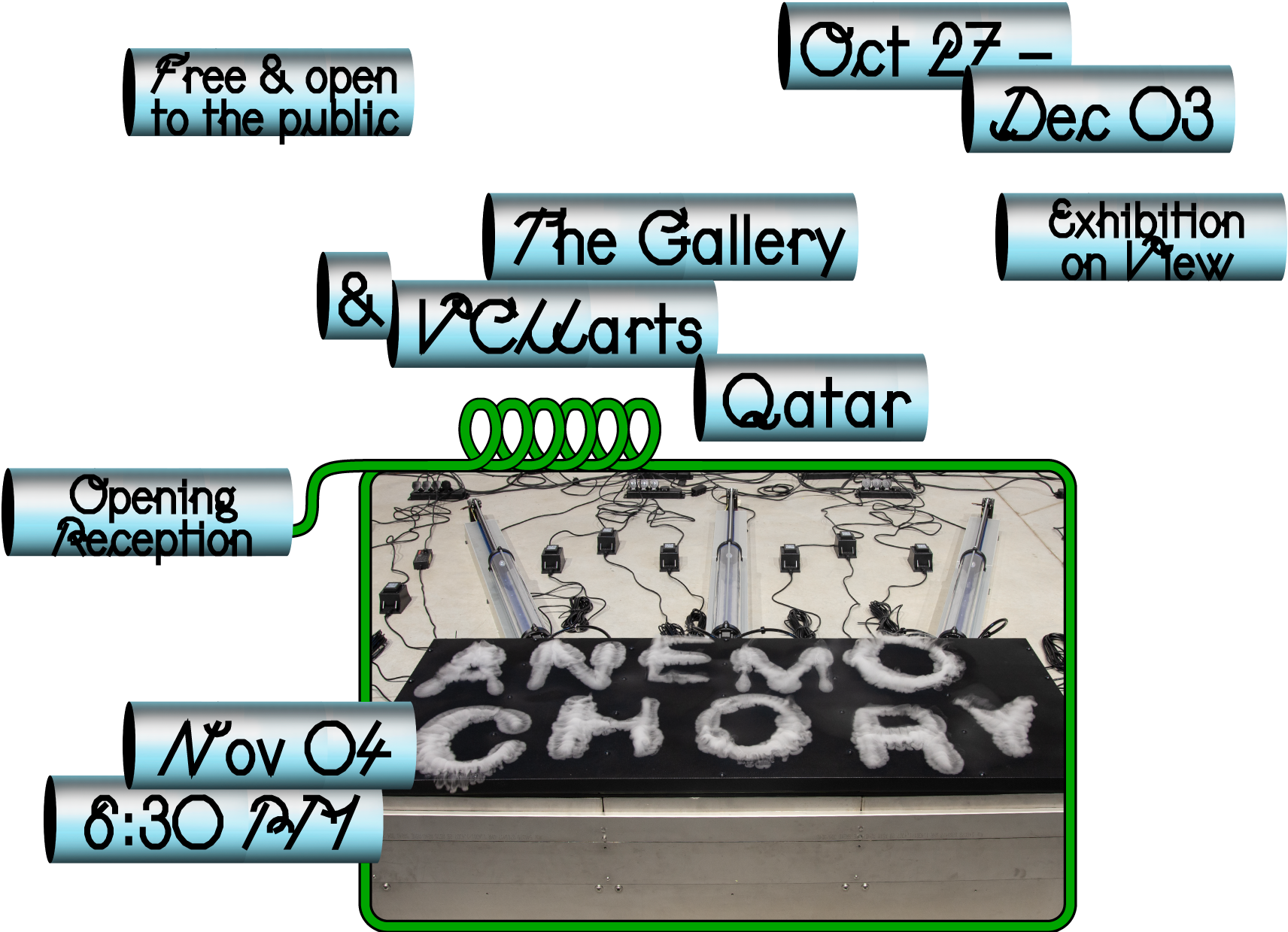
In Lahuis’ Hydrology installations, words temporarily materialize in water vapor, appearing and disappearing as if they were a mantra. Natural processes, technical infrastructure, and textual legibility merge poetically. For this exhibition, the word Anemochory continuously emerges and fades. Anemochory is the wind-driven dispersal of seeds and spores, which becomes a metaphor within the context of this exhibition for the circulation of ideas and knowledge.

Kitab Kebab (For the birds), 2025
Books, metal kebab skewer
A traditional kebab skewer pierces through a selection of books, suggesting not only an analytical but also an affective and digestive relationship with text. The mashed-up reading list proposes a lateral or transversal approach to knowledge, an attempt to combine the rigor of the more traditionally-inclined vertical forms of knowledge with a range of the horizontal.
Mother Tongues and Father Throats, 2012
Woolen yarn
A diagram showing letters of the Arabic alphabet and the corresponding part of the mouth used to pronounce these letters, Mother Tongues and Father Throats turns to the throat as a source of mystical language – contrasting with the tongue’s profane, everyday speech. Here, the artists have added the letters for guttural phonemes [gh] and [kh] in Cyrillic and Hebrew as a nod to these letters’ importance across disparate fields such as Russian Futurism, Kabbalist gematria, and Sufi literature.